
If you've recently pulled your old frying pan out of the drawer and found yourself wondering what that scratched, discoloured coating is doing to your family's meals — you're not alone. Australians are asking this question in growing numbers. And the answer, once you start looking, is both reassuring and slightly unsettling.
The good news: there are genuinely excellent non-toxic frying pans available to Australian shoppers right now. The challenge is cutting through a crowded, often confusing market where every brand claims to be "healthy" and "safe" without telling you much about why.
This guide will help you understand what you're actually looking for — and what to avoid — so you can make a confident choice for your kitchen.
Why does your frying pan coating matter?
Most conventional non-stick frying pans use coatings in the PTFE family — better known by the brand name that's become a household word. PTFE is a type of PFAS (per- and polyfluoroalkyl substances) — synthetic "forever chemicals" that don't break down in the environment or the body.
The concern isn't just theoretical. Research has increasingly linked long-term PFAS exposure to a range of health concerns. And while regulatory bodies continue to study the evidence, many health-aware Australians have decided they'd rather not wait for the consensus — especially when better options are now readily available.
There's also the practical issue of physical coating degradation. A scratched or worn non-stick coating — which describes a large percentage of the pans sitting in Australian kitchens right now — releases particles directly into food during cooking. This is where the real daily exposure risk lies.
If your non-stick pan is scratched, peeling, or more than 2–3 years old — it's time to replace it.
What to look for in a non-toxic frying pan
The term "non-toxic" is used liberally in cookware marketing. Here's what to actually look for when evaluating a pan:
1. PFAS-free and PTFE-free coating
This is non-negotiable. Any pan marketed as "non-toxic" should explicitly state that its coating contains no PFAS, PTFE, or PFOA. If the brand doesn't specify — ask, or walk away.
2. Lead and cadmium free
Heavy metals can appear in coloured coatings and glaze materials. Look for brands that specifically test and certify zero detectable lead and cadmium — especially important if you cook for children.
3. Transparent coating technology
The best brands are open about what their coating is made from. Vague claims like "eco-friendly coating" or "healthy surface" without explaining the chemistry should raise your eyebrows. Look for brands that name their technology and explain the source materials.
4. Induction compatibility (if relevant)
If you have an induction cooktop — increasingly common in Australian homes — you'll need a pan with a ferromagnetic base. Not all ceramic non-stick pans are induction compatible. Always check before buying.
5. A brand with an honest story
The cookware industry is crowded with brands making bold claims. The ones worth trusting tend to be the ones who'll tell you not just what their pan doesn't have — but what it does have, how it's made, and why they made those choices.
The main types of non-toxic frying pans
There are a few different options for Australians going toxin-free. Each has strengths and trade-offs:
🟢 Ceramic Non-Stick (e.g. Ecolon™)
What it is: A silica-based ceramic coating bonded to aluminium — no fluorochemicals required.
Pros: Easy release, easy cleanup, lightweight, available in beautiful colours. Works well for eggs, fish, vegetables and everyday cooking.
Care note: Performs best at low to medium heat with non-metal utensils. Like any non-stick surface, it rewards a bit of care.
🟡 Stainless Steel
What it is: Uncoated steel — completely inert, with no coating at all.
Pros: Virtually indestructible, handles any heat, induction compatible, lasts forever.
Trade-off: Not naturally non-stick. Requires more cooking technique (proper preheating, enough fat) to prevent sticking. Steeper learning curve.
🟡 Cast Iron
What it is: Heavy, uncoated iron — naturally non-stick when seasoned properly.
Pros: Lasts generations, incredible heat retention, develops a natural non-stick surface over time, induction compatible.
Trade-off: Very heavy. Requires regular seasoning and specific cleaning. Not suitable for delicate foods or acidic cooking.
🔴 Carbon Steel
What it is: Similar to cast iron, but lighter. The preferred choice in professional kitchens.
Pros: Lighter than cast iron, heats quickly, develops seasoning, induction compatible.
Trade-off: Less commonly available in Australia, requires seasoning and specific care, reactive with acidic foods.
For most Australian households — especially those making the switch from traditional non-stick — ceramic non-stick is the most intuitive transition. It behaves similarly to what you're used to, but without the chemical concerns.
Choosing a ceramic non-stick frying pan in Australia
Not all ceramic non-stick pans are equal. Here's what separates a pan that will still perform in three years from one that starts sticking within six months:
- Coating thickness and quality: Thicker, multi-layer ceramic coatings last longer and perform more consistently than thin, single-layer coatings typically found in budget pans.
- Body material: Die-cast aluminium bodies are heavier and conduct heat more evenly than pressed aluminium. Weight is usually a sign of quality.
- Handle quality: Riveted handles are more durable than welded or glued. Check that handles are rated for oven use if you plan to finish dishes in the oven.
- Independent testing: Does the brand publish test results or certifications for their coating? The more transparent a brand is, the more you can trust the claim.
- Real reviews: Check platforms like ProductReview.com.au for Australian consumer experiences. Look for patterns in both positive and negative reviews — and pay attention to how the brand responds to problems.
Neoflam: the Australian-owned option worth knowing about
We'll be transparent: this guide is written by Neoflam. So take this section with that in mind — but we've tried to write it as honestly as we'd want to read it.
Neoflam was brought to Australia by three parents from Mullumbimby in NSW's Northern Rivers — a community that's always been ahead of the curve on sustainable, health-conscious living. They discovered the brand because they were concerned about what they were cooking in. They flew to South Korea, investigated the technology and the manufacturing process, and decided it was the real deal. The Australian business has been proudly local ever since.
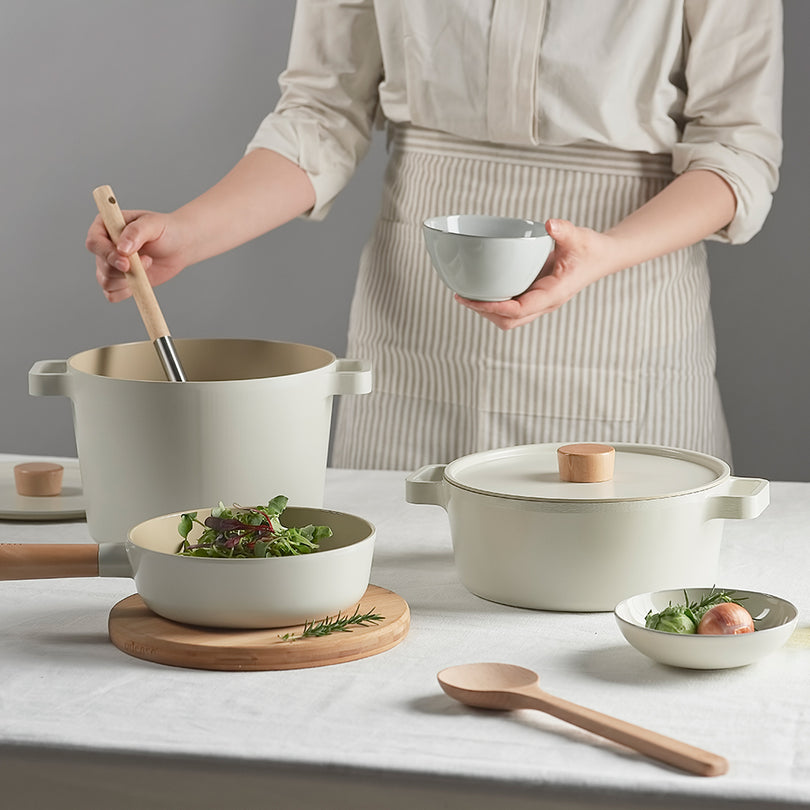
The coating at the heart of every Neoflam pan is Ecolon™ — a ceramic non-stick made from natural silica. It's 100% free from PFAS, PTFE, PFOA, lead, and cadmium, and has been since the very first pan we sold. Not reformulated. Not a marketing update. Just what it was from day one.
OUR MOST POPULAR FRYING PANS
Not sure where to start? These are the Neoflam frying pans Australians reach for most:
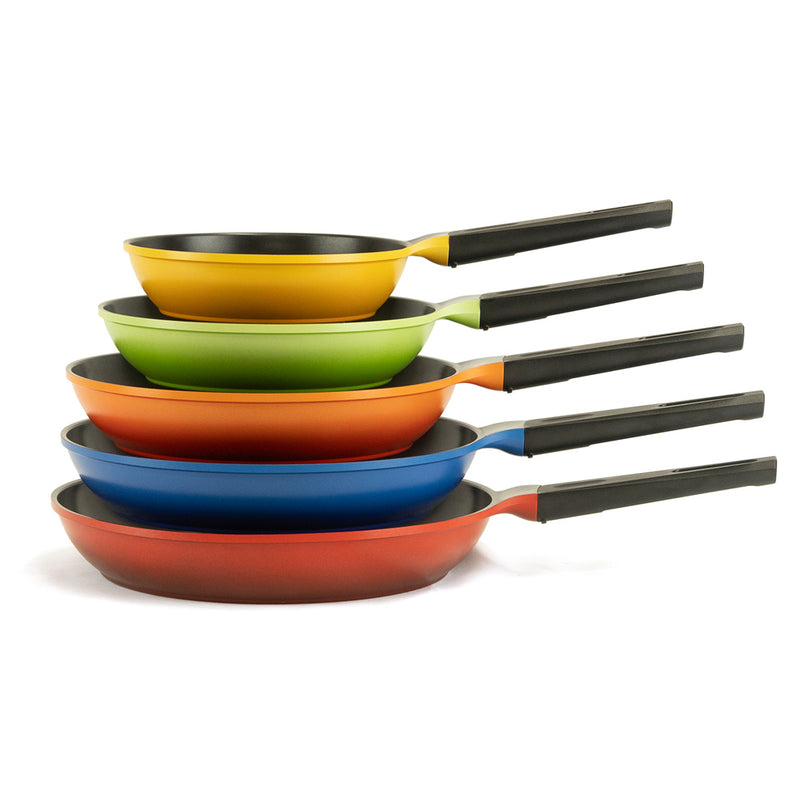
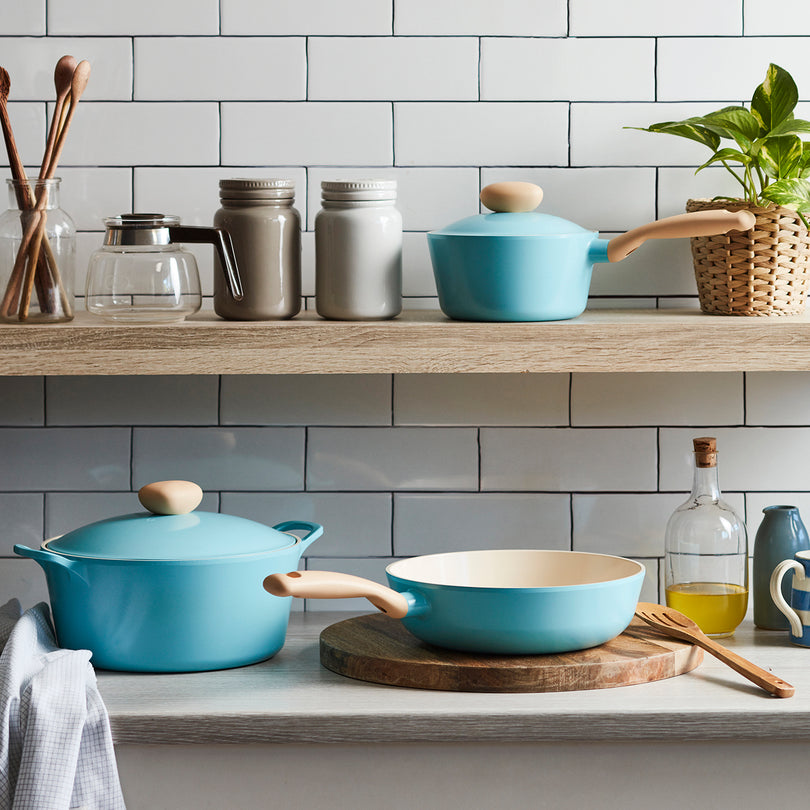
- Retro Fry Pan — Induction compatible, available in bold colours, 24cm or 28cm. The go-to everyday workhorse.
- Fika Fry Pan — Scandi-inspired, neutral tones, induction compatible. For the minimalist kitchen.
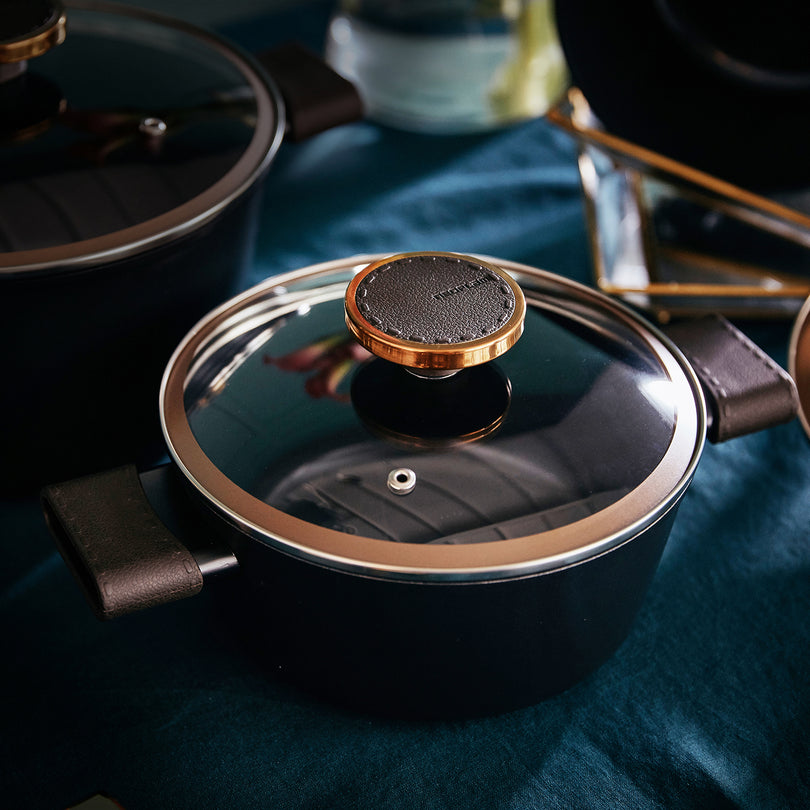
- Vulcan Fry Pan — Dramatic matte black, induction compatible. For kitchens that take cooking seriously.
- Sets & Save — Twin packs and complete sets often discounted 40–50%. The best value entry point.
How to make your non-toxic pan last
Whichever brand you choose, ceramic non-stick cookware performs best — and lasts longest — when you follow a few simple principles:
- Cook on low to medium heat. Ceramic conducts beautifully — you don't need high heat. Prolonged high heat is the #1 reason ceramic coatings degrade prematurely.
- Use wood, bamboo, or silicone utensils. Metal tools will eventually scratch any ceramic surface.
- Hand wash when possible. Dishwashers are hard on ceramic coatings over time. A soft cloth and warm soapy water is all you need.
- Let the pan cool before washing. Thermal shock from cold water on a hot pan weakens the coating bond over time.
- Store with protection. If stacking, place a cloth or protector between pans to prevent surface contact.
Making the switch
Switching to a non-toxic frying pan isn't a dramatic lifestyle overhaul — it's a small, quiet decision that ripples outward every time you cook. The meal tastes the same. The cleanup is just as easy. And you've removed one more source of unnecessary chemical exposure from your family's daily life.
That matters. Especially over years. Especially for children.
If you're ready to make the change, we'd love to be your pan. Browse our range — every single one is Ecolon™ coated, PFAS-free, and made with the care that started in a small town in northern NSW.
READY TO COOK CLEAN?